Inspection Period vs. As-Is Inspection | Buyer Guide
Inspection Period vs. As-Is Inspection: What Buyers Need to Understand Before Going Under Contract
Buying a home is exciting, emotional, and occasionally feels like trying to read a foreign language while standing in a tornado.
You finally find the house. You love the kitchen. The backyard is giving “cookout season.” The primary bedroom has space for your real furniture and not just a bed and a dream. You are ready to write the offer.
Then the contract conversation starts.
Your Realtor says something like:
“Do you want to write this with an inspection period or as-is with inspection rights?”
And suddenly, your brain says:
“Excuse me? I thought we were buying a house, not taking the bar exam.”
So let’s slow it down and talk about it.
When you go under contract on a home, the inspection language in your offer matters. It can affect your negotiating power, your repair options, your earnest money, your ability to walk away, and your overall peace of mind.
Today, we are breaking down the difference between going under contract with a traditional inspection period versus going under contract with an as-is inspection.
And no, “as-is” does not always mean “take it or leave it and good luck, buttercup.”
Let’s get into it.
First, What Is a Home Inspection?
A home inspection is a professional evaluation of the property’s condition.
The inspector looks at major components of the home, including things like:
Roof
Foundation
Electrical
Plumbing
HVAC
Windows and doors
Attic and insulation
Crawl space or basement
Appliances
Exterior grading and drainage
Safety concerns
Structural issues
Signs of moisture, leaks, mold, or previous damage
The inspection is not meant to tell you whether the couch would look good in the living room. That part is on you and Pinterest.
The inspection is meant to help you understand what you are buying.
Because once you own the home, the problems become your problems. And some problems are minor. Some are expensive. Some are “call your uncle, your contractor, and maybe the Lord” level.
A home inspection gives buyers information before they fully commit to moving forward.
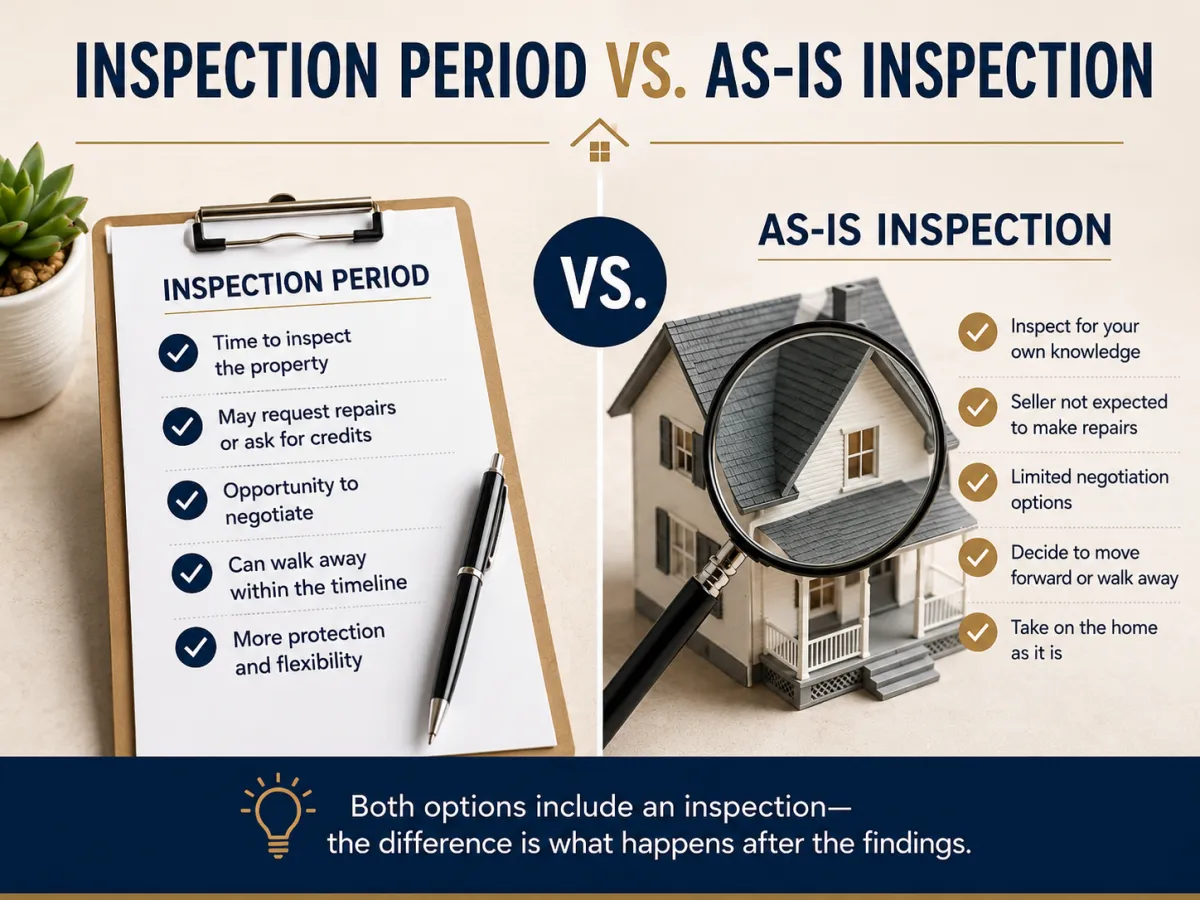
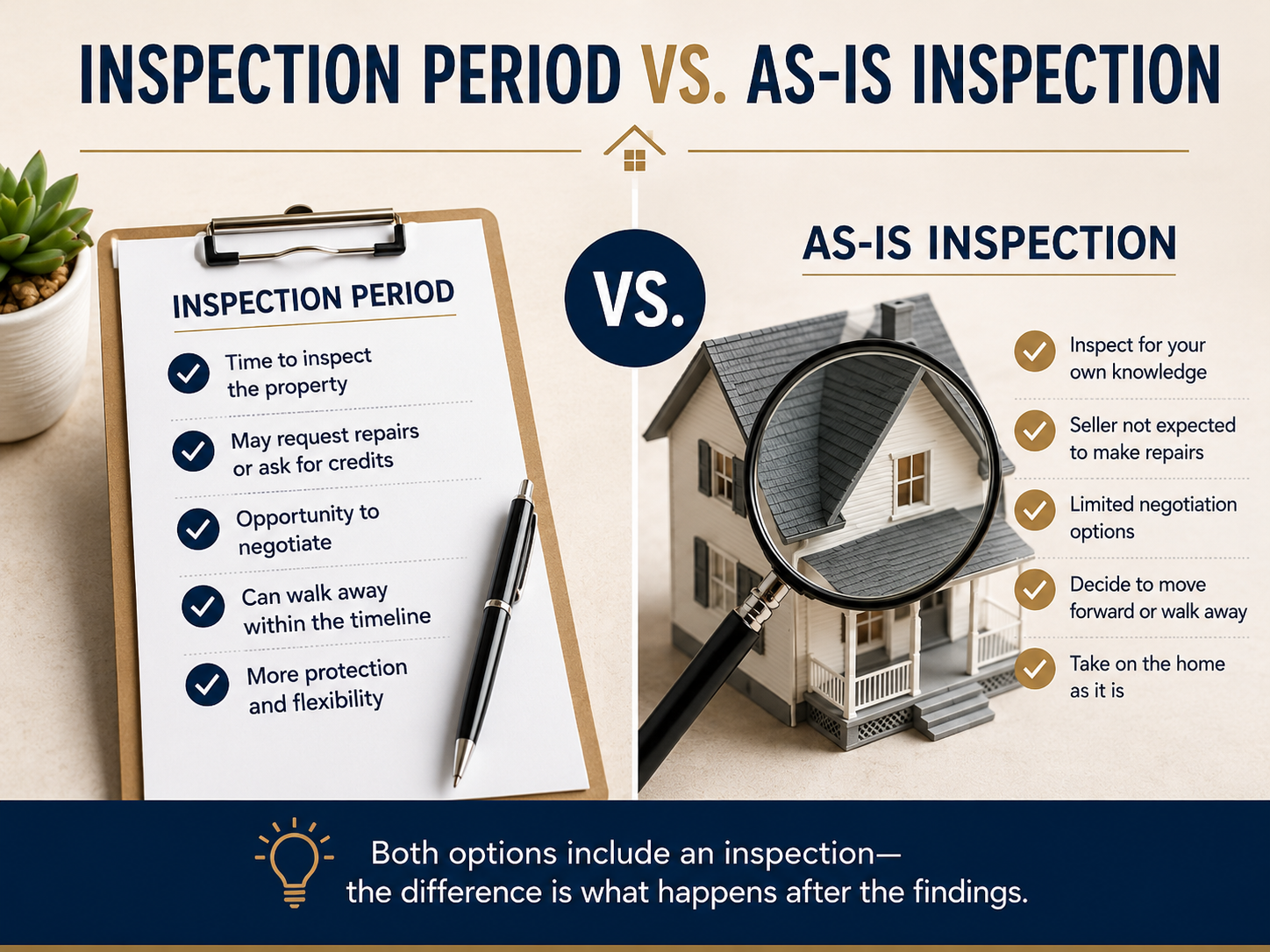
What Does It Mean to Go Under Contract With an Inspection Period?
When you go under contract with a standard inspection period, the buyer usually has a set number of days to complete inspections and respond based on the findings.
That inspection period is your due diligence window.
During this time, the buyer can hire inspectors, review reports, ask questions, and decide how they want to proceed.
Depending on the contract terms, the buyer may have the option to:
Accept the home as it is
Ask the seller to make repairs
Ask for a credit or concession instead of repairs
Ask for a price reduction
Renegotiate certain terms
Walk away if the inspection reveals issues they are not comfortable with
This is the more traditional inspection setup many buyers think of when purchasing a home.
The buyer gets time to investigate the property, and if something major comes up, there may be room to negotiate with the seller.
Example of a Traditional Inspection Period
Let’s say you go under contract on a home and have a 7-day inspection period.
Your inspector goes out and finds:
The water heater is near the end of its life
A few outlets are not grounded
The HVAC needs servicing
There is a small plumbing leak under the kitchen sink
The roof has some older shingles but is not actively leaking
With a traditional inspection period, you may choose to send an inspection response asking the seller to address some of those items.
You might say:
“Seller to repair plumbing leak, service HVAC, and have electrical outlets corrected by a licensed electrician prior to closing.”
The seller can say yes.
The seller can say no.
The seller can offer something different.
The seller can say, “We will fix the plumbing leak, but we are not touching the HVAC.”
Then both sides decide if they can come to an agreement.
This is where your Realtor helps you understand what is reasonable, what is common, what is worth pushing for, and what might blow up the deal over something small.
Because yes, some buyers will try to negotiate over a cracked light switch cover like they just discovered buried treasure. Let’s not be that buyer.
What Is an As-Is Inspection?
Now let’s talk about as-is.
An as-is inspection means the seller is saying they are selling the property in its current condition and generally do not want to make repairs.
That does not mean the buyer should skip the inspection.
That does not mean the buyer has no rights.
That does not mean the house is automatically falling apart.
It means the seller is telling buyers upfront:
“This is the condition of the home. Please inspect it, but do not expect us to do a long repair list.”
In many cases, buyers can still have an inspection period when purchasing as-is. The big difference is the expectation around repairs and negotiation.
With an as-is inspection, the buyer is typically inspecting for their own knowledge and protection.
The inspection helps the buyer decide:
Am I comfortable moving forward?
Are the repairs manageable?
Are there major issues I did not expect?
Do I still want this home at this price?
Do I need to walk away?
Do I want to attempt to renegotiate, understanding the seller may say no?
The inspection is still valuable. It just functions a little differently.
“As-Is” Does Not Mean “No Inspection”
Let me say this louder for the people in the back:
As-is does not mean no inspection.
Please do not hear “as-is” and think you should just skip the inspection because the seller does not want to make repairs.
That is like buying a used car without checking if it has brakes because the seller said, “It runs.”
Great. But does it stop?
Even when buying as-is, you still want to understand the condition of the property.
An inspection may reveal that the house needs normal maintenance. That may be fine.
Or it may reveal major concerns, such as:
Foundation movement
Roof damage
Active water intrusion
Mold concerns
Sewer line problems
Unsafe electrical work
HVAC failure
Structural damage
Termite damage
Drainage issues
Plumbing problems behind walls
Some buyers are comfortable taking on repairs.
Some buyers are not.
Some investors expect repairs.
Some first-time buyers need a home that is more move-in ready.
The point is not that every issue is a dealbreaker. The point is that you should know what you are walking into.
Surprises are great for birthdays. Not so much for sewer lines.
The Biggest Difference: Repair Expectations
The main difference between a traditional inspection period and an as-is inspection comes down to repair expectations.
With a traditional inspection period, the buyer may have more room to request repairs or negotiate after the inspection.
With an as-is inspection, the seller is usually signaling that they do not intend to make repairs.
That does not always mean negotiations are impossible. But it does mean the buyer should not go into an as-is offer assuming they can send over a 22-item repair list and the seller will happily grab a toolbox.
They probably will not.
In an as-is situation, the seller may still consider negotiation if the inspection reveals something major that was unknown or unexpected.
For example:
A failed septic system
A dangerous electrical issue
A major roof leak
A furnace that does not work
Structural concerns
A sewer scope showing significant damage
But the seller is not obligated to agree.
The buyer can ask.
The seller can say no.
That is the part buyers need to understand before they fall in love with a house and start mentally decorating the guest bathroom.
Can a Buyer Still Send an Inspection Response on an As-Is Home?
In many cases, yes.
This is where buyers often get confused.
Some people think as-is means:
“I cannot ask for anything.”
That is not always true.
A buyer may still have the right to send an inspection response depending on the contract language and terms. However, the seller also has the right to reject the request.
So yes, you may be able to ask.
But no, the seller does not have to agree.
That is why the wording of the offer matters.
That is also why you need a Realtor who understands how to explain the strategy before you submit the offer, not after everyone is stressed and reading the inspection report like it is a horror novel.
Why Would a Seller List a Home As-Is?
A seller may choose to sell as-is for several reasons.
It does not always mean the home is in terrible condition.
Sometimes the seller simply does not want to deal with repairs.
Common reasons include:
The seller inherited the property
The seller has already priced the home based on condition
The seller is relocating
The seller does not have the funds for repairs
The seller wants a cleaner, faster transaction
The home needs updates and the seller knows it
The seller is an investor
The property is part of an estate
The seller has never lived in the home
The seller wants buyers to do their own due diligence
Some as-is homes are rough.
Some are perfectly livable but need updates.
Some are clean, solid homes where the seller simply does not want to negotiate over repairs.
As-is is not automatically a red flag.
But it is a yellow light.
It means slow down, pay attention, and know what you are agreeing to.
Why Would a Buyer Agree to an As-Is Inspection?
A buyer may agree to as-is terms for several reasons.
In a competitive market, offering as-is may make the offer more attractive to the seller because it reduces the chance of repair negotiations later.
Investors often buy as-is because they already plan to renovate.
Some buyers are willing to accept cosmetic issues or older systems if the price, location, or opportunity makes sense.
A buyer may choose as-is if:
The home is priced well
They have funds set aside for repairs
They are comfortable with the condition
They want to make their offer stronger
They are competing against other buyers
They plan to renovate anyway
They understand the risk
The inspection period still allows them to walk away if the home is worse than expected
As-is can be a strategy.
But it should be an informed strategy.
Not a “we panicked and wanted the house” strategy.
That is how buyers end up eating ramen in a house with a broken furnace.
Inspection Period vs. As-Is Inspection: The Simple Breakdown
Here is the easiest way to think about it.
A traditional inspection period says:
“I want time to inspect the home, and depending on what we find, I may ask the seller to make repairs, give credits, adjust the price, or let me walk away.”
An as-is inspection says:
“I want time to inspect the home, but I understand the seller is not planning to make repairs. After inspections, I will decide whether I am comfortable moving forward, asking for something anyway, or walking away if the contract allows.”
Both can protect the buyer.
The difference is how much negotiation is expected after the inspection.
What Buyers Should Focus on During Any Inspection
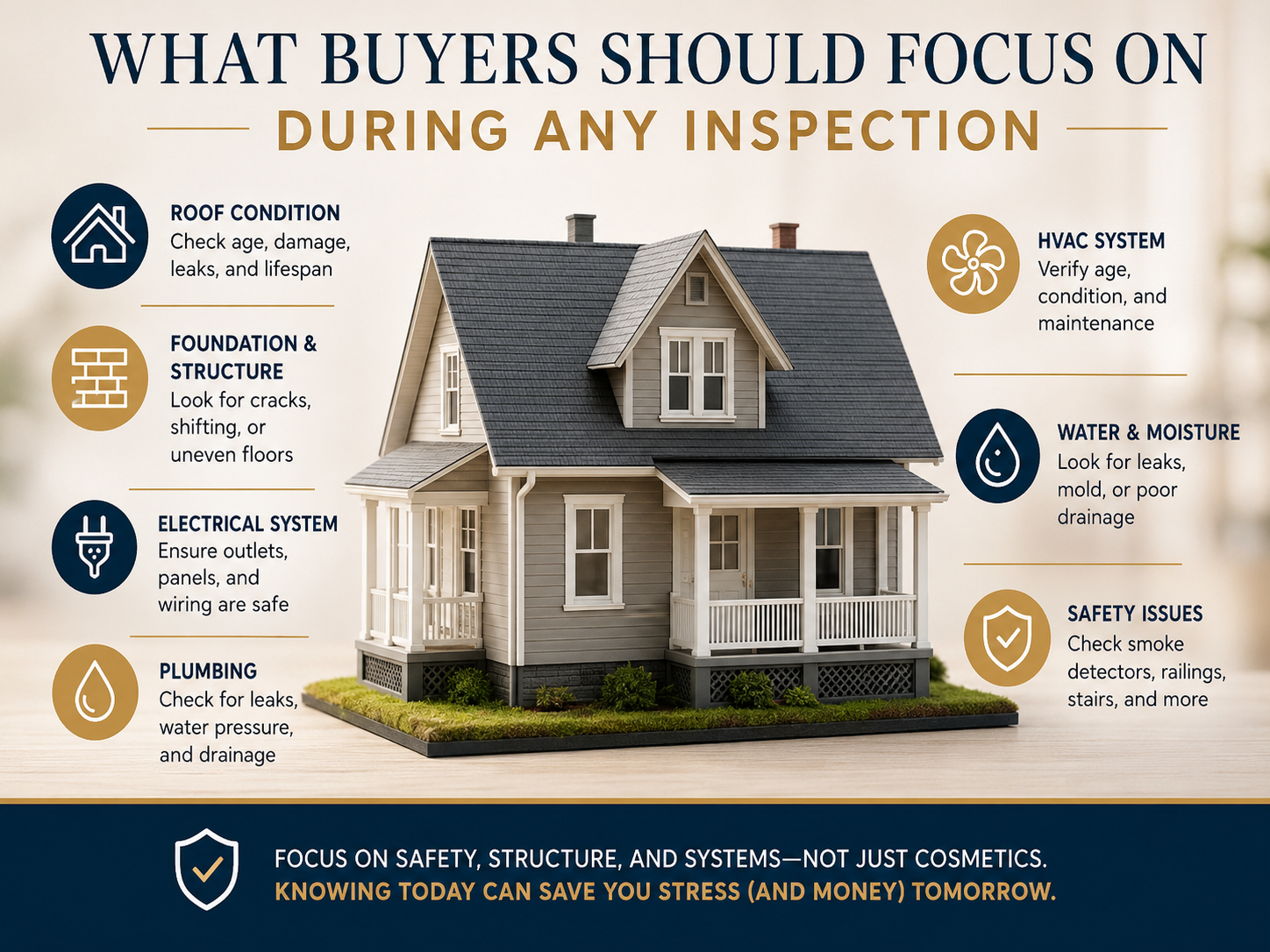
Whether you have a traditional inspection period or an as-is inspection, buyers should focus on the big stuff.
I know the chipped paint on the baseboard may bother you. I understand. I, too, enjoy a house that does not look like a toddler fought the trim.
But inspection negotiations should usually focus on health, safety, structural, mechanical, and expensive concerns.
Pay close attention to:
1. Roof Condition
A roof can be one of the most expensive repairs on a home.
You want to know:
Approximate age
Condition of shingles
Signs of leaks
Flashing concerns
Soft spots
Gutter or drainage issues
Whether repairs or replacement may be needed soon
A roof that has five years left is different from a roof that is already waving the white flag.
2. Foundation and Structural Concerns
Foundation issues can be serious and expensive.
Watch for:
Large cracks
Bowing walls
Uneven floors
Doors that do not close properly
Water intrusion in basement or crawl space
Signs of settling
Not every crack is a catastrophe, but structural concerns deserve attention.
3. Electrical Issues
Electrical problems can create safety risks.
Common concerns include:
Double-tapped breakers
Outdated panels
Ungrounded outlets
Exposed wiring
Improper DIY work
Overloaded circuits
Missing GFCI protection near water areas
Electrical repairs can range from simple to expensive, so buyers need clarity.
4. Plumbing Problems
Plumbing issues can be sneaky.
Look for:
Leaks
Low water pressure
Old supply lines
Drainage problems
Water heater concerns
Signs of prior water damage
Sewer line issues
If the home is older, a sewer scope may be worth considering. Nobody wants to buy a house and then immediately meet the sewer line in a very personal and expensive way.
5. HVAC System
Heating and cooling matter, especially in Indiana where the weather likes to act like it has multiple personalities.
You want to know:
Age of furnace and AC
Whether systems are functioning
Maintenance history
Signs of rust, leaks, or poor airflow
Estimated remaining life
An older HVAC system is not automatically bad, but buyers should budget accordingly.
6. Water Intrusion and Moisture
Water is one of the biggest enemies of a home.
Inspectors may look for:
Basement moisture
Crawl space moisture
Roof leaks
Plumbing leaks
Grading issues
Mold-like substances
Poor ventilation
Drainage problems
Water issues can lead to bigger problems if ignored.
7. Safety Issues
Safety items may include:
Missing handrails
Loose stairs
Trip hazards
Missing smoke detectors
Missing carbon monoxide detectors
Unsafe deck construction
Broken windows
Improper venting
These are often items buyers should take seriously, especially if children, elderly family members, or guests will be in the home.
What Buyers Should Not Panic Over
Every inspection report will find something.
Every. Single. One.
Even brand-new homes can have inspection items.
A home inspection report is not a “bad house report.” It is a condition report.
Some items are normal maintenance.
Common non-panic items may include:
Minor caulking needed
Small drywall cracks
Loose doorknobs
Missing outlet covers
Dirty furnace filter
Minor grading adjustments
Older appliances that still work
Worn weatherstripping
Minor cosmetic flaws
Small areas needing paint or touch-up
That does not mean you ignore them. It just means everything does not need to become a full courtroom drama.
A good Realtor helps you separate “this is important” from “this is annoying but normal.”
There is a difference between “the furnace is not working” and “the closet door squeaks.”
One is a negotiation item.
The other is a $6 can of WD-40 and a deep breath.
What Happens After the Inspection?
After the inspection, the buyer usually has to decide what to do before the deadline in the contract.
Depending on the type of inspection terms, options may include:
Move forward without asking for anything
Ask the seller for repairs
Ask for a seller credit
Ask for a price adjustment
Ask for further evaluation by a specialist
Cancel the contract if allowed under the terms
Accept the property as-is and plan repairs after closing
The key is timing.
Inspection deadlines matter.
If your contract gives you a certain number of days, you need to complete inspections, review reports, discuss options, and submit any response within that timeframe.
This is not the time to “circle back later.”
Real estate deadlines do not care that life got busy. They are very rude like that.
Seller Credits vs. Seller Repairs
Sometimes buyers ask whether it is better to request repairs or ask for a credit.
The answer depends on the situation.
A repair request means the seller handles the repair before closing.
A credit means the seller gives money toward the buyer’s allowable closing costs or prepaid expenses, depending on loan rules and contract terms.
A price reduction lowers the purchase price but may not give the buyer immediate cash to make repairs after closing.
Each option has pros and cons.
Repairs May Make Sense When:
The issue must be fixed before closing
The lender may require the repair
It is a safety concern
It affects insurance
The buyer does not want to handle it after closing
Credits May Make Sense When:
The buyer wants control over who does the work
The repair does not need to happen before closing
The seller does not want to coordinate contractors
The buyer prefers to make the repair after moving in
The issue is more about budgeting than immediate safety
Price Reductions May Make Sense When:
The buyer wants a better deal overall
The seller will not agree to repairs or credits
The repair cost is difficult to finalize before closing
The buyer has cash available to handle the repair later
This is why your Realtor and lender need to communicate. Seller credits must fit within loan guidelines, and not every credit can be used however the buyer wants.
A seller cannot always just hand the buyer money after closing like it is a birthday card from Grandma.
Lending rules matter.
What About FHA, VA, USDA, and Conventional Loans?
The type of loan can also impact how inspection and repairs are handled.
A home inspection is different from an appraisal.
The inspection is mainly for the buyer’s knowledge.
The appraisal is for the lender to determine value and, depending on the loan type, whether the home meets certain minimum property requirements.
Some loan programs may be more sensitive to property condition.
For example, government-backed loans may require certain safety, security, or habitability items to be addressed before closing.
This can include things like peeling paint in certain situations, missing handrails, utilities not being on, broken windows, roof concerns, or other issues that affect basic safety or livability.
That does not mean buyers using FHA, VA, or USDA cannot buy an as-is home.
But it does mean condition matters.
If the lender or appraiser requires repairs before closing, someone has to address them for the loan to move forward.
And if the seller is selling as-is and refuses to make repairs, that can create a problem.
This is why strategy matters before writing the offer.
The type of financing, the condition of the home, and the seller’s willingness to negotiate all need to work together.
Real estate has moving parts. Basically, it is a group project with money, deadlines, and occasional chaos.
When an As-Is Offer May Not Be the Best Fit
An as-is offer is not always the right move.
It may not be ideal if:
You do not have money set aside for repairs
You need the home to be move-in ready
You are uncomfortable with unknowns
The home appears to have major deferred maintenance
Your loan type may require repairs
You are stretching your budget already
You are buying with limited cash after closing
You are not prepared to walk away if the inspection is bad
Buying a home is not just about getting the offer accepted.
It is about getting the right home under the right terms.
Winning the offer but inheriting a repair nightmare is not the prize we are looking for.
That is not a victory lap. That is a very expensive plot twist.
When an As-Is Offer May Make Sense
An as-is offer may make sense if:
You understand the property condition
You still have inspection rights
You have repair funds available
You are buying below market value
You are an investor or handy homeowner
You want to make your offer more competitive
You are comfortable with some risk
The home’s location, layout, or potential makes it worthwhile
You are not relying on the seller to fix everything
As-is can be a tool.
But like any tool, you need to know how to use it.
A hammer is helpful. A hammer in the wrong hands is a hole in the wall and somebody saying, “I thought I had it.”
Questions Buyers Should Ask Before Writing the Offer
Before deciding between a traditional inspection period and an as-is inspection, buyers should ask:
How competitive is this home?
Are there multiple offers?
What condition does the home appear to be in?
How old are the major systems?
Do I have money available for repairs after closing?
What type of loan am I using?
Could my loan require certain repairs?
Am I comfortable if the seller says no to repairs?
What would make me walk away?
What is my maximum comfort level if repairs are needed?
That last question is important.
Before inspections happen, buyers should think about their boundaries.
For example:
“I can handle cosmetic updates.”
“I can handle a few thousand dollars in repairs.”
“I cannot handle roof replacement right away.”
“I do not want foundation issues.”
“I am okay with an older HVAC if it works.”
“I need the home to be safe and functional on day one.”
When buyers know their limits upfront, inspection decisions become less emotional and more strategic.
What Buyers Should Remember About Inspection Reports
Inspection reports can feel overwhelming.
They are usually long, full of photos, and written in a way that can make even minor issues sound intense.
Remember this:
The inspector’s job is to document what they see.
Your Realtor’s job is to help you understand what it may mean in the context of your contract, your goals, and the negotiation.
A 60-page inspection report does not automatically mean the house is bad.
Inspectors include photos, notes, explanations, safety recommendations, maintenance tips, and observations.
Some items are immediate concerns.
Some are future maintenance.
Some are “keep an eye on this.”
Some are “fix this when you get around to it.”
The goal is not perfection.
No home is perfect.
The goal is understanding.
The Real Purpose of an Inspection
The inspection is not just about asking the seller for repairs.
The inspection is about informed decision-making.
It helps you understand:
What you are buying
What repairs may be needed soon
What maintenance to plan for
What safety items matter
What costs could come after closing
Whether the home still makes sense for you
That is valuable whether the contract is traditional or as-is.
The inspection gives you knowledge.
And in real estate, knowledge is not just power.
Knowledge is protection.
My Buyer Advice
Do not skip inspections just to make an offer look stronger unless you fully understand the risk.
Do not assume as-is means you have no options.
Do not assume a traditional inspection period means the seller has to fix everything.
Do not panic over every small item in the inspection report.
And please, do not fall so in love with the house that you ignore expensive issues.
The goal is not just to get the keys.
The goal is to get the keys with confidence.
A beautiful kitchen is wonderful, but if the crawl space is holding water like a backyard pond, we need to talk.
Final Thoughts: The Contract Terms Matter
Going under contract with an inspection period and going under contract with an as-is inspection are not the same thing.
Both can work.
Both can protect buyers when written properly.
Both require buyers to understand their rights, responsibilities, and deadlines.
The difference is the expectation.
A traditional inspection period usually leaves more room for repair requests and negotiation.
An as-is inspection usually means the buyer is inspecting to decide whether they want to move forward, with less expectation that the seller will make repairs.
But every contract is different.
Every home is different.
Every buyer’s comfort level is different.
That is why having the right Realtor matters.
Because buying a home is not just about finding the one with the cute kitchen and the good backyard.
It is about understanding the paperwork, the deadlines, the risks, the negotiation points, and the decisions that protect you from saying later:
“Well… nobody told me that.”
And friend, that is exactly what I do not want for you.
Before you write an offer, make sure you understand what kind of inspection terms you are agreeing to. The language matters. The timeline matters. Your comfort level matters.
Because the best buyers are not just excited buyers.
They are informed buyers.
And informed buyers make stronger, smarter, more confident decisions.
Thinking About Buying a Home?
If you are thinking about buying a home and want someone to walk you through the process in a way that actually makes sense, I would love to help.
From offer strategy to inspections to closing day, my goal is to help you understand what is happening, why it matters, and how to protect yourself along the way.
Buying a home is a big deal.
You deserve to feel prepared, not pressured.